
The boardrooms of India's large listed companies are steadily expanding as corporate governance standards tighten and regulatory compliance rises. Boards of Nifty 100 companies boasted an average of 10.52 members as of FY24, compared to 9.86 in FY21 and 10.48 in FY23, according to the fifth edition of Excellence Enablers' Survey on Corporate Governance, an initiative led by M Damodaran, former chairman of the Securities and Exchange Board of India (Sebi).

The ratio of market capitalisation to gross domestic product (GDP) in India remains elevated despite the recent correction in the equities markets. It was 147.5 per cent on December 3, 56 per cent higher than the 10-year average of 94 per cent. The current ratio is slightly lower than the all-time high ratio of 154 per cent at the end of September this year.

Among the new entries, the largest by market capitalisation are LIC, Avenue Supermarts (DMart), Adani Green Energy, Zomato and Jio Financial Services.

India Inc continued to grapple with muted revenue growth in the September 2024 quarter (Q2FY25) and witnessed a decline in margins and profits. The headwinds were especially severe for non-financial companies, while banking, financial services, and insurance (BFSI) firms significantly outpaced the rest of the corporate sector. The total profit of 1,353 listed companies that have released their Q2FY25 results thus far dropped by 0.6 per cent year-on-year (Y-o-Y) - the first cumulative earnings decline in eight quarters.

China has stayed on top for two consecutive months in the MSCI Emerging Markets Investable Market Index (EM IMI), after ceding the position to India in August. At the end of October, China's weight in the key EM gauge stood at 24.72 per cent, up from 21.58 per cent at the end of August. India's weight during this period has slipped to 20.42 per cent from 22.27 per cent.

On the cusp of launching its Rs 11,327 crore initial public offering (IPO) next week, food and grocery delivery major Swiggy believes quick commerce to be its future growth engine and anticipates that it will outpace its core food delivery business over the next five years. Currently, the quick commerce business of Swiggy - backed by Prosus and SoftBank - is 40 per cent of the size of its food delivery revenues.

There has been a sharp slowdown in revenue and profit growth in the cement sector in recent quarters but it is yet to show in the share prices of cement companies. On the contrary, there has been a rally in cement stocks and a re-rating of their equity valuation in the past three years despite an earnings contraction during the period.

Hyundai Motor India Limited's (HMIL's) record Rs 27,870 crore initial public offering (IPO) may not have set the primary market alight with sky-high subscription levels, but it has spelled a windfall for the five investment banks steering the share sale. The Indian arm of the South Korean carmaker paid Rs 493 crore - 1.77 per cent of the issue size - in fees and commissions to the book running lead managers (BRLMs), marking the largest-ever payout for an IPO in the country.

Hyundai Motor India (HMIL) raised Rs 8,315 crore from anchor investors on Monday, setting the stage for the country's biggest-ever maiden share sale. The Indian arm of the South Korean carmaker Hyundai Motor Company (HMC) allotted 42.4 million shares to 225 funds at Rs 1,960 apiece, the higher end of its price band. Among the investors receiving allotments were the Singapore government's sovereign wealth fund (GIC), New World Fund, and Fidelity.

India's stock markets are experiencing a shift in investor sentiment, with a 30 per cent surge in Chinese stocks, prompting investors to move money from domestic markets to China. This reversal of fortunes is a notable change from the past three years, where China's losses benefited India.

India's second-largest passenger vehicles firm will be valued at Rs 1.59 trillion at the top-end of the price band of Rs 1,865-Rs 1,960.

The Indian markets have delivered high long-term returns, second only to the US.
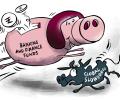
Companies in the banking, finance sector and insurance (BFSI) sector have underperformed on the bourses despite leading the earnings growth charts in the post-pandemic period. This has created a dichotomy between their earnings and share prices. BFSI companies have never been less expensive than the rest of the equity market.

The Securities and Exchange Board of India (Sebi) on Monday approved the introduction of a new asset class, designed to offer greater flexibility to fund managers and target investors with a higher risk appetite. The markets regulator also cleared the liberalised Mutual Funds Lite (MF Lite) framework, aimed at fund houses that solely launch passively managed schemes. In another significant move, the board reduced the timeframe for rights issues from the current 317 working days to just 23.

India's financial sector is dominated by large government-owned and private-sector banks.

Bajaj Housing Finance Ltd's impressive stock market debut has brought cheer to the 100-year-old Bajaj Group, but the conglomerate faces the prospect of Bajaj Finserv being removed from the benchmark Sensex index. According to market expectations, Trent, a Tata group-owned fashion retailer, is likely to replace Bajaj Finserv during the upcoming index rebalancing in December.

The last four years, the best for corporate profits in a long time, have not been as impressive for corporate capital expenditure. The combined net profits of India's top listed companies excluding banks, financial services, and insurance (BFSI) increased at a compound annual growth rate (CAGR) of 32.4 per cent since FY20, a sharp jump from the 7.4 per cent in corporate earnings between FY14 and FY19.

During the first eight months of CY24, 50 IPOs mobilised Rs 53,453 crore.

The greater the post-listing gains, the higher the number of investors looking to sell.

After four years of high double-digit growth in profits, corporate earnings of Indian companies hit a speed bump in the April-June quarter of 2024 (Q1FY25), leading to the risk of a downward revision in India Inc profit estimates for FY25 and volatility in the equity market. Earnings growth slowed despite companies in most non-financial sectors reporting higher operating margins from lower commodity prices and a decline in interest costs.
